

Ethereum (ETH) Explained: How It Works and How to Buy ETH on Gate TR
Beginner
EthereumLast Updated 2026-10-13 04:03:56
ETH, also known as Ether, is the native cryptocurrency of the Ethereum network. It is used to pay transaction fees, interact with decentralized applications, and participate in Ethereum’s proof-of-stake consensus system. Understanding Ethereum therefore involves looking at both the network itself and the role ETH plays within it. Ethereum.org
This guide explains how Ethereum works, its core technologies, the role of ETH, and how to buy ETH on Gate TR. It also reviews recent network developments without relying on price data or market forecasts.
Key Takeaways
- Ethereum is a blockchain platform: It supports smart contracts and decentralized applications rather than serving only as a digital payment network.
- ETH is Ethereum’s native asset: It is used for network transaction fees and contributes to network security through staking.
- Ethereum uses proof of stake: Validators help process transactions and maintain consensus by participating in the network’s consensus mechanism.
- Layer 2 networks support scaling: They process transactions outside Ethereum mainnet while using Ethereum for some combination of data availability and settlement.
- Ethereum continues to evolve: The Pectra and Fusaka upgrades introduced changes related to wallet functionality, data availability, and network capacity. Further protocol development remains ongoing.
- ETH can be traded on Gate TR: Users can visit the ETH/USDT and ETH/TRY spot markets, review the available order options, and place an order according to their needs.
What Is Ethereum (ETH)?
Ethereum is a public, decentralized blockchain that functions as a programmable platform. Unlike a traditional database controlled by one organization, Ethereum maintains a shared record of transactions and smart contract activity across a distributed network of computers.
The network’s programmability is one of its defining features. Developers can deploy smart contracts—programs stored and executed on the blockchain—to support financial applications, digital collectibles, token issuance, decentralized governance, and other use cases. These contracts can follow predefined rules without requiring a centralized operator to process every action.
ETH is the native cryptocurrency of this ecosystem. The terms Ethereum and Ether are often used interchangeably in everyday conversation, but they refer to different things: Ethereum is the network and software platform, while ETH is the asset used within that network.
How Does Ethereum Work?
Ethereum combines a blockchain, an execution environment for smart contracts, and a consensus mechanism. Together, these components allow network participants to submit transactions, execute applications, and agree on the network’s current state.
1.Blockchain and Distributed Nodes
Ethereum records transactions in blocks that are linked together cryptographically. Nodes maintain and verify blockchain data according to the network’s rules, helping participants independently check transactions and the resulting state of the system.
When a user sends ETH or interacts with a smart contract, the transaction is broadcast to the network. It is then processed according to Ethereum’s rules and included in a block. Once the network reaches consensus on the relevant block, the transaction becomes part of the shared ledger.
2. Smart Contracts and the Ethereum Virtual Machine
Smart contracts are programs deployed on Ethereum. They can define how tokens are transferred, how decentralized applications operate, or how specific conditions must be met before an action can occur.
The Ethereum Virtual Machine (EVM) provides the execution environment for compatible smart contracts. It processes contract instructions according to standardized rules, enabling applications to operate across the Ethereum network.
For example, a decentralized exchange can use smart contracts to execute token swaps, while a lending application can use them to manage deposits, collateral, and repayments. These applications still depend on their own contract design and implementation, so users should not assume that every application built on Ethereum has the same security properties.
3. Proof of Stake and Validators
Ethereum transitioned from proof of work to proof of stake in September 2022. Under the proof-of-stake system, validators participate in proposing and confirming blocks instead of relying on the mining process used by proof-of-work networks.
Validators stake ETH as part of their participation in consensus. They run validator software, verify network activity, and perform assigned duties. Protocol rules can penalize certain forms of dishonest or incorrect behavior, including through the loss of some staked ETH.
This system is central to Ethereum’s transaction processing and network security. Staking is a protocol-level function, however, and it is distinct from simply holding ETH in an exchange account. Ethereum proof of stake documentation
What Is ETH Used For?
ETH has several functions within Ethereum’s technical and application ecosystem.
Paying Network Transaction Fees
Ethereum uses a fee mechanism known as gas to measure the computational resources required to process a transaction or execute a smart contract. Users pay these network fees in ETH when they perform actions on Ethereum mainnet.
The fee depends on the amount of computation required and network conditions when the transaction is processed. A simple ETH transfer and a more complex smart contract interaction may require different amounts of gas.
These network fees are separate from any trading fees charged by a cryptocurrency exchange. If you buy ETH through Gate TR, for example, the exchange’s order fees and any later blockchain withdrawal fees are different from the gas fee required to execute a transaction on Ethereum. Ethereum gas documentation
Participating in Network Security
ETH is also used in Ethereum’s proof-of-stake consensus mechanism. Validators stake ETH to participate in network operations, and protocol rules determine how their participation is handled.
Some users participate directly by operating validators, while others may access staking through third-party services. These arrangements have different technical requirements and risks. Buying ETH on an exchange does not automatically mean that the ETH is staked or that the account holder is operating a validator.
Using Decentralized Applications
ETH is used across many applications built on Ethereum. Depending on the application, it may be used to pay transaction fees, exchange assets, provide collateral, or settle transactions.
Ethereum also supports tokens created through smart contracts. These tokens can represent stablecoins, governance rights, digital collectibles, and other blockchain-based assets. ETH is not the same as these application-specific tokens, even when they operate on the same network.
Ethereum’s Ecosystem: DeFi, Stablecoins, NFTs, and Layer 2
Ethereum’s smart contract capabilities have supported a broad ecosystem of applications. Understanding these categories helps explain why ETH is used for more than direct transfers between addresses.
Decentralized Finance (DeFi)
DeFi applications use smart contracts to provide blockchain-based financial functions. Depending on the protocol, users may be able to exchange tokens, supply assets to lending markets, or interact with other on-chain financial services.
The rules and risks vary by application. Smart contract vulnerabilities, protocol design, liquidity conditions, and third-party dependencies can affect how these services operate.
Stablecoins and Tokenized Assets
Ethereum hosts stablecoins and many other tokenized assets. These tokens follow smart contract rules and can be transferred or used by compatible applications. A token’s presence on Ethereum does not mean that it is issued or guaranteed by the Ethereum network itself; the issuer or protocol responsible for the token determines its specific properties.
NFTs and Digital Ownership
Non-fungible tokens are blockchain-based tokens designed to distinguish individual items or records. Ethereum has been used for NFTs representing digital art, collectibles, gaming assets, and other forms of digital ownership.
The token records and related smart contracts can help track ownership and transfers, but they do not automatically determine the legal rights attached to an item or guarantee the long-term availability of associated media.
Layer 2 Scaling Networks
Ethereum mainnet provides the base layer for transaction execution and settlement, while Layer 2 networks aim to process activity more efficiently. Many Layer 2 systems use rollups, which execute transactions outside the main chain and publish data or proofs to Ethereum according to their designs.
These systems can have different security assumptions, withdrawal procedures, fees, and levels of decentralization. Users should check the specific network and application before transferring assets, especially when moving tokens between Ethereum mainnet and a Layer 2 network.
Recent Ethereum Network Developments
Ethereum development continues through protocol upgrades that change how the network processes transactions, handles data, and supports users and developers. Two important upgrades already implemented are Pectra and Fusaka. Ethereum’s official roadmap
Pectra: Wallet Functionality and Network Changes
Pectra was activated on Ethereum mainnet in May 2025. Among its changes, it introduced EIP-7702, which allows externally owned accounts to temporarily use smart-contract functionality within a transaction. This supports wallet features such as transaction batching and gas sponsorship when compatible services implement them.
Pectra also changed validator staking parameters and increased the target and maximum number of data blobs per block. Blobs are a type of data storage mechanism used by rollup-based scaling systems. These changes formed part of Ethereum’s ongoing work on user experience and Layer 2 data capacity. Ethereum roadmap
Fusaka: Data Availability and Network Capacity
Fusaka was activated in December 2025. A key component is PeerDAS, or Peer-to-Peer Data Availability Sampling, which changes how participating nodes check the availability of blob data. Instead of requiring every participating node to download all blob data, the mechanism allows nodes to sample portions of it.
Fusaka also included blob parameter-only upgrades, allowing blob capacity parameters to be adjusted through smaller protocol changes. These developments are relevant to Ethereum’s relationship with rollups and its broader approach to scaling. They do not mean that every Layer 2 network has identical performance or security properties. Ethereum roadmap
Ongoing Protocol Development
Ethereum’s development work continues across scalability, user experience, security, and decentralization. The Glamsterdam upgrade is in development, with its proposed changes including protocol-level work on block building and block-level access lists. Its final scope and implementation details should be checked against the official roadmap as development progresses.
Ethereum’s roadmap is maintained by researchers, client teams, and contributors across the ecosystem. Proposed upgrades can change during development, so planned features should not be treated as completed network capabilities until they have been implemented. Ethereum roadmap
Ethereum vs. ETH: What Is the Difference?
The distinction is straightforward but useful for new users.
| Term | Meaning |
|---|---|
| Ethereum | The decentralized blockchain network and programmable application platform |
| Ether (ETH) | The native cryptocurrency used for transaction fees and other network functions |
| Smart contract | A program deployed on Ethereum that executes according to its code and network rules |
| Gas | A unit used to measure the computational work required for Ethereum operations |
| Validator | A participant that helps secure Ethereum and reach consensus under proof of stake |
| Layer 2 | A network or system designed to process transactions outside Ethereum mainnet while relying on it for specified functions |
In short, Ethereum is the network, while ETH is the native asset that helps power its operation.
How to Buy ETH on Gate TR
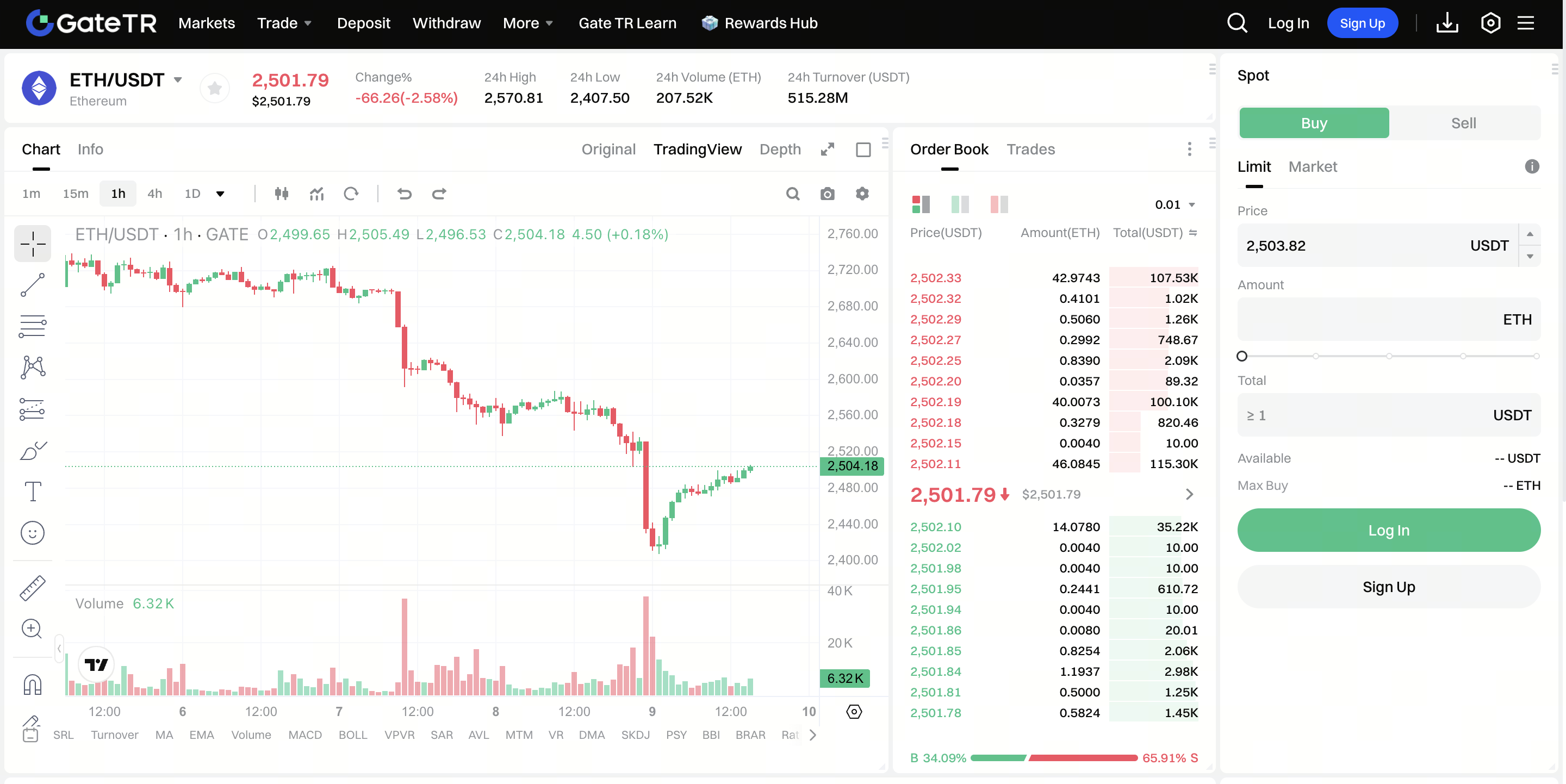
You can use the ETH/USDT spot market on Gate TR to trade ETH against USDT. Before placing an order, confirm that you are using the intended market and review the order details shown on the platform.
Step 1: Open the ETH/USDT Market
Visit the ETH/USDT spot trading page on Gate TR. Check the trading pair at the top of the page to make sure you have selected ETH/USDT rather than another ETH market.
Step 2: Sign In to Your Gate TR Account
Sign in to your account. If you are new to Gate TR, complete the account setup and any verification required for the features you want to use. The available account functions may depend on the platform’s current requirements and your account status.
Step 3: Review Your Available Balance
Check that your account has sufficient USDT or TRY available for the order. If you need to deposit assets first, review the deposit options and make sure the selected asset and network match the instructions provided by Gate TR.
Step 4: Choose an Order Type
The available order options are displayed in the trading interface. Common spot order types include:
- Market order: An order intended to execute against available orders at the best prices currently offered in the order book. The final execution price may differ from the last displayed price, especially when liquidity changes.
- Limit order: An order that specifies the price at which you are willing to buy ETH. It may not execute if the market does not reach the specified price or if sufficient matching orders are unavailable.
Check the order type, quantity, and estimated total before submitting. The exact interface and available options may change.
Step 5: Submit and Check Your Order
Enter the amount of ETH you want to buy or the USDT amount you want to use, as supported by the interface. Review the order details, including any applicable trading fee, and submit the order if everything is correct.
After submission, check the order status. A market order may execute immediately against available liquidity, while a limit order may remain open until it is filled, canceled, or otherwise handled according to the platform’s rules. Once the order has executed, review your account balance to confirm the ETH received.
Step 6: Review How You Want to Hold Your ETH
After buying ETH, you can keep it in your exchange account or consider withdrawing it to a compatible wallet. If you withdraw, verify the destination address and network carefully. Selecting an incompatible network or entering an incorrect address can result in an irreversible loss of assets.
Buying ETH on Gate TR does not automatically transfer it to Ethereum mainnet, and holding ETH on the exchange is different from holding it in a self-custody wallet.
Important Considerations Before Buying ETH
Before buying ETH, it is useful to understand several practical points.
- Market risk: ETH is a crypto asset, and its market value can change. A purchase does not guarantee a particular outcome.
- Network fees: Sending ETH or interacting with Ethereum applications may require gas fees. These are separate from exchange trading fees.
- Order execution: Market orders prioritize execution against available liquidity, while limit orders may not be filled.
- Custody: Keeping assets on an exchange and managing a self-custody wallet involve different responsibilities and security considerations.
- Network selection: When withdrawing ETH or transferring assets, confirm that the receiving platform or wallet supports the selected network.
- Application risk: Ethereum-based applications and tokens have their own technical and operational risks. The Ethereum network does not guarantee the safety of every application built on it.
These considerations can help users understand the mechanics of buying and using ETH without confusing the asset, the Ethereum network, and third-party services.
Summary
Ethereum is a programmable blockchain that supports smart contracts, decentralized applications, and a wide range of digital assets. ETH is the network’s native cryptocurrency, used to pay transaction fees and participate in proof-of-stake security. Recent upgrades such as Pectra and Fusaka have introduced changes to wallet functionality, data availability, and network capacity, while protocol development continues.
For users who want to buy ETH on Gate TR, the ETH/USDT spot market provides a direct place to review the available order options and submit a spot order. Before trading or transferring ETH, check the market, order details, fees, custody arrangements, and network compatibility.
Frequently Asked Questions
What is Ethereum (ETH)?
Ethereum is a decentralized blockchain network that supports smart contracts and decentralized applications. ETH, or Ether, is its native cryptocurrency and is used for transaction fees and other network functions.
What is ETH used for?
ETH is used to pay Ethereum gas fees, interact with applications, transfer value, and participate in the network’s proof-of-stake consensus system. Its specific use depends on the activity and application involved.
How does Ethereum differ from Bitcoin?
Bitcoin is primarily designed as a peer-to-peer digital currency and payment network. Ethereum also supports value transfers, but it adds a programmable environment for smart contracts and decentralized applications. Their technical designs and consensus mechanisms are different.
Does Ethereum use proof of stake?
Yes. Ethereum uses proof of stake. Validators stake ETH and perform consensus duties to help process transactions and maintain the network. The system includes protocol rules and penalties for certain types of improper behavior.
What are Ethereum gas fees?
Gas fees pay for the computational resources required to process transactions and execute smart contracts on Ethereum. Fees are paid in ETH and vary according to the work required and network conditions.
How can I buy ETH on Gate TR?
You can visit the ETH/USDT spot market, sign in to your Gate TR account, check your available USDT balance, select an available order type, and review the order before submitting it. Confirm the execution status after placing the order.
What is the difference between Ethereum mainnet and Layer 2 networks?
Ethereum mainnet is the base blockchain. Layer 2 networks are designed to process transactions outside the main chain while relying on Ethereum for specified functions, such as settlement or data availability. Their operating models and security assumptions vary, so users should verify network compatibility before transferring assets.
Disclaimer
* Legal Notice 1: This content does not constitute investment advice. It is not intended to promote the buying/selling of digital assets and is for informational purposes only. Crypto assets carry high risks and may be subject to significant price fluctuations. Before making any investment decision, you should assess your own financial situation and make an independent decision.
* Legal Notice 2: The data and charts provided in the article are for general informational purposes only. Although all content is carefully prepared, no responsibility is accepted for possible errors or omissions. The Gate TR Learn team may translate this content into different languages. No translated article may be copied, reproduced, or distributed without permission.
Share
Content
Key Takeaways
What Is Ethereum (ETH)?
How Does Ethereum Work?
What Is ETH Used For?
Ethereum’s Ecosystem: DeFi, Stablecoins, NFTs, and Layer 2
Recent Ethereum Network Developments
Ethereum vs. ETH: What Is the Difference?
How to Buy ETH on Gate TR
Important Considerations Before Buying ETH
Summary
Frequently Asked Questions


Sign Up
Related Articles

Beginner
Ether.fi (ETHFI) Nedir?
Ether.fi, diğer staking platformlarından farklı olarak, stake edenlere anahtarlarını yönetme özerkliği veren, saklama dışı (un-custodial) bir staking protokolüdür. Ethereum'un Proof of Stake (PoS) ekosisteminde, iki tür anahtar üretilir: çekim anahtarları ve doğrulama anahtarları. Çekim anahtarı, bir kullanıcının varlıklarını çekmek için kullanılırken, doğrulama anahtarı, düğüm operatörleri tarafından belirli bir süre içinde blokları doğrulamak ve böylece doğrulama ödülleri kazanmak için gereklidir.
2025-07-14 07:18:44

Beginner
What is Ethereum 2.0? What Does Merger Mean?
What is Ethereum 2.0? What Does Merger Mean?
2025-11-27 07:37:10
Beginner
10 Years of Ethereum: A Detailed Review from Inception to Today
10 Years of Ethereum: A Detailed Review from Inception to Today
2025-11-18 06:52:13