What Is Quant (QNT)? A Guide to QNT and How to Buy It on Gate TR
Last Updated 2026-09-29 07:42:33
QNT has recently attracted increased attention following several developments involving Quant’s technology and financial infrastructure. In September 2026, The Clearing House announced that it had selected Quant to support its On-Chain Money Initiative, an interoperable payments network designed to enable financial institutions to clear and settle tokenized deposit transactions.
For users researching QNT, understanding the role of Quant Network, the purpose of the QNT token, and how QNT can be traded on a local TRY market can provide useful context. Gate TR supports a QNT/TRY spot trading pair, allowing eligible users to trade QNT against Turkish lira.
Key Takeaways
- QNT is the native utility token associated with Quant Network, a project focused on blockchain interoperability and financial infrastructure.
- Quant’s Overledger provides API-based technology designed to connect multiple blockchain networks and traditional financial systems.
- QNT has utility within the Quant ecosystem, including use for accessing Quant’s Overledger platform and services. Quant states that its platform can be paid for in USD or QNT.
- Quant has recently received attention following developments involving tokenized deposits and financial infrastructure, including The Clearing House’s selection of Quant for its On-Chain Money Initiative.
- Gate TR provides a QNT/TRY spot market, allowing users to trade QNT using Turkish lira.
- Users should review the available market, order type, fees, and account requirements before placing a trade.
What Is QNT?
QNT is the utility token associated with Quant Network. Quant was created around the goal of improving interoperability between different blockchain networks and connecting distributed ledger technology with existing financial infrastructure.
Rather than operating solely as a general-purpose blockchain, Quant’s technology is centered on Overledger, which Quant describes as an API-based platform for interoperability. Overledger is designed to connect blockchain networks, digital assets, payment infrastructure, banking systems, and other financial applications.
The project describes interoperability as a way to reduce fragmentation between otherwise separate blockchain networks. Overledger provides standardized interfaces that allow applications and institutions to work across multiple networks without having to build separate integrations for every blockchain.

What Is Quant Network?
Quant Network is a technology company focused on blockchain interoperability and programmable money infrastructure.
Its current product ecosystem includes Overledger, Quant Flow Platform, QuantNet, and Quant Fusion. Quant describes its broader focus as helping banks, financial institutions, and capital markets connect and program digital money and assets.
What Is Overledger?
Overledger is Quant’s interoperability platform.
According to Quant, Overledger works as a universal API connector between blockchain networks and traditional financial systems. Its functions include multi-chain interoperability, cross-chain transactions, multi-chain smart contract execution, and connectivity between digital assets and existing financial infrastructure.
This means the core idea behind Quant is not simply creating another standalone blockchain. Instead, the project focuses on the infrastructure required to allow different distributed ledgers and financial systems to communicate with one another.
What Is QNT Used For?
QNT has utility within the Quant ecosystem.
Quant’s official FAQ states that QNT is its utility token and can be used with Overledger. Quant also states that users can pay for its platform in either USD or QNT.
Historically, Quant has also documented QNT support within Overledger’s payment infrastructure. Its Overledger documentation lists QNT among the ERC-20 tokens supported by its payment API.
The role of QNT should therefore be understood in the context of Quant’s broader interoperability and financial infrastructure products rather than as a standalone payment network.
Why Is QNT Trending?
QNT has recently received significant attention following developments related to Quant’s role in financial infrastructure.
On September 24, 2026, The Clearing House announced that it had selected Quant to provide technology for its On-Chain Money Initiative. According to The Clearing House announcement published by Quant, the initiative is designed as an interoperable payments network for financial institutions, with Quant providing the interoperability, orchestration, and transaction-management layer and connectivity to existing payment systems including RTP and CHIPS.
Quant’s announcement said the network is intended to support the clearing and settlement of tokenized deposit transactions. The planned network is expected to open to participating institutions in the first half of 2027.
Separately, Quant has been involved in other tokenized-money and financial infrastructure projects. Its official materials describe applications involving tokenized deposits, programmable payments, interoperability, and connections between blockchain-based assets and traditional financial systems.
These developments have contributed to increased market attention around QNT. However, developments involving Quant’s technology and movements in QNT’s market price are separate matters. News about a project’s technology adoption does not by itself determine the future price of its token.
How to Buy QNT on Gate TR
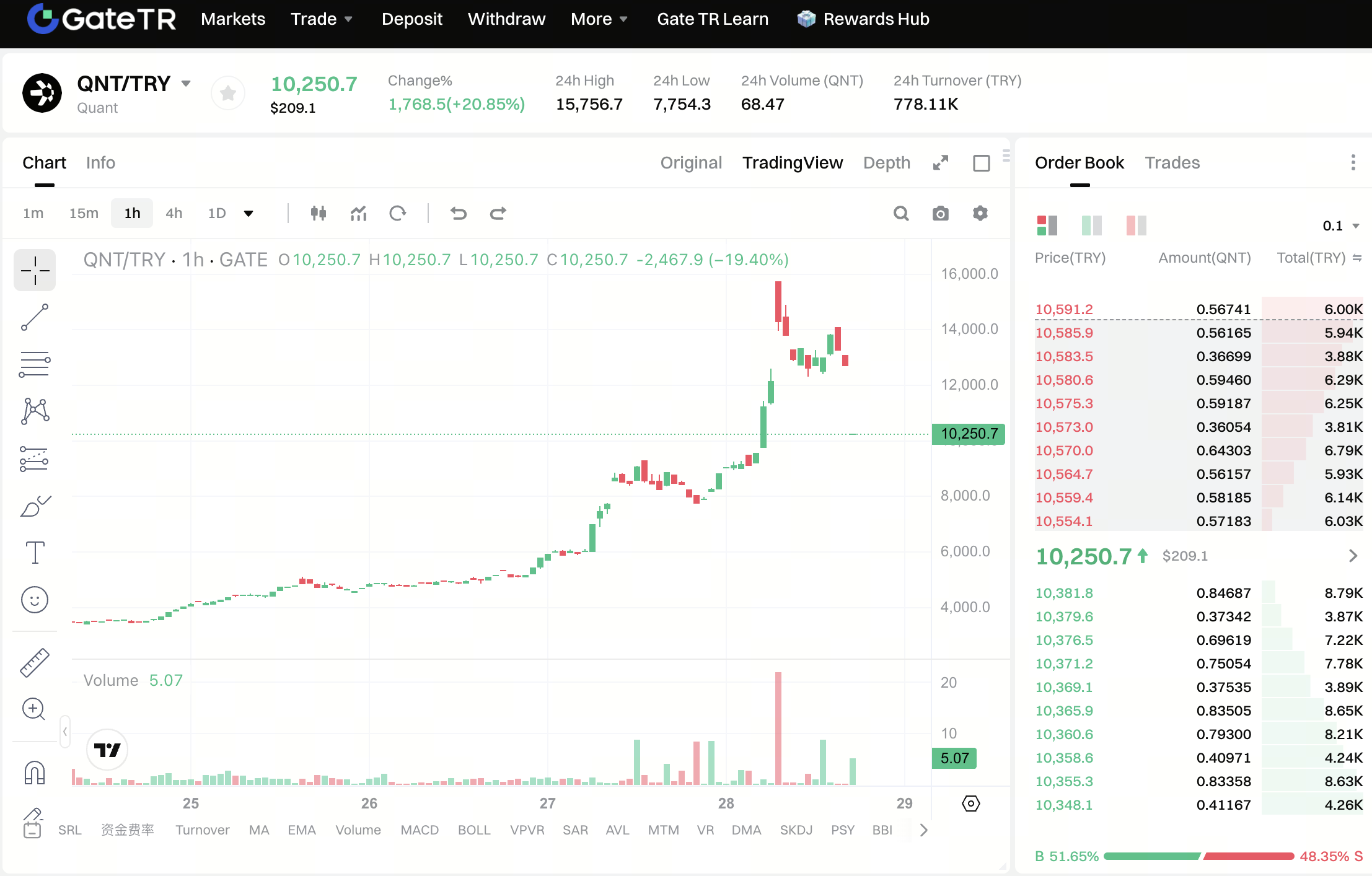
Gate TR provides a QNT/TRY spot trading market. Users who want to trade QNT against Turkish lira can access the QNT/TRY market through Gate TR’s spot trading interface.
Before trading, make sure your Gate TR account has completed any required identity verification and that sufficient TRY is available in the account.
Step 1: Create or Log In to Your Gate TR Account
If you do not already have a Gate TR account, create one and complete the required account verification steps.
Existing users can log in to their Gate TR account and proceed to the trading interface.
Step 2: Complete Required KYC Verification
Gate TR requires identity verification for services that require KYC.
The current individual verification process includes entering personal information, verifying the phone number, ID and NFC verification, uploading proof of address, and completing a liveness check. After the initial review is completed, users are required to join a video call. Once all verification steps are successfully completed, users must make a minimum deposit of 1 TRY. After that, the account is ready to use.
If your account has not completed the required verification, complete the Gate TR identity verification process before proceeding.
Step 3: Make TRY Available in Your Account
To trade the QNT/TRY pair, you need to have enough TRY in your Gate TR account.
Depositing Turkish lira into your Gate TR account is easy:
- Go to the TRY Deposit page.
- Select one of Gate TR’s bank accounts and copy the IBAN.
- Open the money transfer page in your banking app.
- Enter the copied IBAN and the amount you want to deposit.
- After confirming the transaction, the Turkish lira will be transferred to your Gate TR account shortly.
Once the TRY balance is credited to your account, you can start trading the QNT/TRY pair.
For more information, please see our Turkish Lira Deposit guide.
Step 4: Open the QNT/TRY Spot Market
Go to the Gate TR spot trading interface and search for QNT/TRY.
You can also access the QNT/TRY trading page directly:
The QNT/TRY market allows users to place spot buy or sell orders using Turkish lira.
Step 5: Choose an Order Type
Gate TR’s spot trading interface supports different order types, including market and limit orders.
Market order: A market order is designed to execute against the best available prices in the order book. Users generally specify the amount they want to buy or sell rather than setting a specific execution price.
Limit order: A limit order allows users to specify the price and amount they want to trade. The order is executed only when matching market conditions are available.
For a QNT/TRY purchase, review the current order book and select the order type that matches your trading requirements.
Step 6: Enter the Amount and Place the Order
Enter the amount of QNT you want to buy or the amount of TRY you want to spend.
Review the displayed price, amount, and other order information before submitting the order.
After confirming the details, select Buy to place the QNT/TRY order.
Step 7: Check Your QNT Balance
After the order is filled, the purchased QNT will be reflected in your Gate TR account according to the platform’s account and settlement process.
You can check your assets through the Gate TR account interface and review your order history to confirm the transaction.
Things to Check Before Buying QNT
Before trading QNT/TRY, users can review several pieces of information on the Gate TR trading interface.
Check the QNT/TRY Trading Pair
Make sure the selected market is QNT/TRY if you intend to use Turkish lira to trade QNT.
Gate TR also supports other TRY-denominated cryptocurrency markets, so checking the trading pair before submitting an order can help avoid selecting the wrong market.
Review the Order Book
The order book displays current buy and sell orders for the selected market. Gate TR describes bids as buy orders and asks as sell orders, with available quantities shown at different price levels.
Reviewing the order book can help you understand the available market depth before submitting an order.
Check Trading Fees
Trading fees can vary depending on the account and applicable fee schedule. Check the current Gate TR fee information before placing an order.
Check the Latest Project Information
QNT has recently received attention because of developments involving Quant’s financial infrastructure. Since project developments and market conditions can change, users should check current information rather than relying only on older articles or social media discussions.
Frequently Asked Questions About QNT
What is QNT?
QNT is the utility token associated with Quant Network. Quant focuses on blockchain interoperability and financial infrastructure, with Overledger serving as its API-based interoperability platform.
What is Quant Network used for?
Quant focuses on connecting different blockchain networks and traditional financial infrastructure. Its Overledger platform provides APIs and tools for interoperability, cross-chain transactions, tokenization, and other multi-network applications.
Why is QNT trending?
QNT has recently attracted attention following developments involving Quant’s role in financial infrastructure. On September 24, 2026, The Clearing House announced that it had selected Quant to support its On-Chain Money Initiative for tokenized deposit clearing and settlement.
Can I buy QNT with TRY?
Yes. Gate TR provides a QNT/TRY spot trading market. Users with access to the relevant Gate TR services can trade QNT against Turkish lira.
How do I buy QNT on Gate TR?
After logging in and completing any required verification, make TRY available in your Gate TR account, open the QNT/TRY spot market, select a market or limit order, enter the desired amount, review the order details, and submit the buy order.
Does Gate TR support QNT spot trading?
Yes. Gate TR currently provides the QNT/TRY spot trading pair.
Is QNT the same as Quant Network?
QNT and Quant Network are related but refer to different things. Quant Network refers to the project and its technology ecosystem, while QNT is the utility token associated with that ecosystem.
Where can I trade QNT on Gate TR?
You can trade QNT against Turkish lira through the QNT/TRY spot market on Gate TR.
Disclaimer
* Legal Notice 1: This content does not constitute investment advice. It is not intended to promote the buying/selling of digital assets and is for informational purposes only. Crypto assets carry high risks and may be subject to significant price fluctuations. Before making any investment decision, you should assess your own financial situation and make an independent decision.
* Legal Notice 2: The data and charts provided in the article are for general informational purposes only. Although all content is carefully prepared, no responsibility is accepted for possible errors or omissions. The Gate TR Learn team may translate this content into different languages. No translated article may be copied, reproduced, or distributed without permission.
Share
Content
Key Takeaways
What Is QNT?
What Is Quant Network?
What Is QNT Used For?
Why Is QNT Trending?
How to Buy QNT on Gate TR
Things to Check Before Buying QNT
Frequently Asked Questions About QNT


Sign Up
Related Articles

Beginner
The Legal Journey of Cryptocurrencies in Turkey
This content outlines the definition, historical development, underlying reasons, and necessities of cryptocurrency regulations in Turkey.
2025-11-18 08:41:34

Beginner
What is HyperGPT (HGPT)?
This article offers an in-depth look into the infrastructure, products, and ecosystem of the HyperGPT (HGPT) project, while focusing on the problems that HyperGPT aims to solve.
2025-05-16 18:10:16