

Bitcoin (BTC) Guide: How Bitcoin Works and How to Buy BTC on Gate TR
Beginner
BitcoinLast Updated 2026-10-13 04:08:42
BTC is the native asset of the Bitcoin network. It can be transferred between compatible wallets, used by businesses that accept Bitcoin payments, and traded on cryptocurrency platforms. Unlike programmable blockchain platforms primarily designed to host general-purpose smart contracts, Bitcoin focuses on peer-to-peer value transfer and a monetary system governed by publicly verifiable protocol rules.
This guide explains how Bitcoin works, how mining and the halving mechanism affect BTC issuance, what distinguishes Bitcoin from other cryptocurrencies, and how to buy BTC on Gate TR. It also covers practical considerations for account verification, order execution, and securely transferring Bitcoin.
Key Takeaways
- Bitcoin is a decentralized network: It records transactions on a public blockchain without relying on a single organization to maintain the ledger.
- BTC is Bitcoin’s native asset: It can be transferred between wallets and is used for payments and other supported purposes.
- Bitcoin uses proof of work: Miners compete to produce valid blocks, while network nodes independently verify transactions and blocks against the protocol rules.
- Bitcoin has a predefined issuance schedule: New BTC enters circulation through block rewards, which are reduced by half approximately every 210,000 blocks.
- Bitcoin transactions use the UTXO model: Each transaction spends eligible outputs from earlier transactions and creates new outputs.
- BTC is available on Gate TR: Users can access the BTC/USDT spot market, review the order options, and place a spot order after completing any required account procedures.
What Is Bitcoin (BTC)?
Bitcoin is an open-source, peer-to-peer monetary network. Its design allows users to send and receive BTC without asking a central operator to approve each transfer. Instead, transactions are broadcast to the network and checked against Bitcoin’s consensus rules.
The blockchain acts as a shared record of confirmed transactions. Network participants can independently verify that transactions follow the protocol, including whether the inputs being spent are valid. This structure helps the network coordinate ownership records without maintaining a conventional account database controlled by one institution.
Bitcoin was introduced under the pseudonym Satoshi Nakamoto. Its original design combined digital signatures, a peer-to-peer network, and proof of work to address the problem of coordinating digital payments without a central authority. The identity of Satoshi Nakamoto remains unconfirmed.
BTC and Bitcoin refer to related but different concepts. Bitcoin is the network and protocol, while BTC is the currency transferred and recorded through that system.
How Does Bitcoin Work?
Bitcoin relies on several components that work together: digital wallets, cryptographic signatures, transactions, miners, and network nodes. Each component has a distinct role in transferring BTC and maintaining a consistent blockchain.
1.Wallets and Private Keys
A Bitcoin wallet helps users manage the information needed to receive and spend BTC. It generates or manages keys and addresses, constructs transactions, and signs outgoing transactions when authorized by the user.
A private key is secret information used to produce a valid cryptographic signature. The signature allows the network to verify that a transaction has been authorized by someone who controls the relevant spending key. A Bitcoin address, by contrast, is information that can be shared to receive funds.
Wallets do not all work in the same way. Some are managed by service providers, while others give users direct control over their private keys. Self-custody provides control over the keys but also makes the user responsible for safeguarding recovery information. Losing access to a self-custody wallet may mean losing access to the BTC it controls.
2.Transactions and the Blockchain
When a user sends BTC, their wallet creates a transaction and broadcasts it to the network. Nodes check whether the transaction follows Bitcoin’s rules, including whether its inputs can be spent and whether the transaction’s signatures are valid.
Valid transactions can wait in a pool of unconfirmed transactions before a miner includes them in a block. Once a block is accepted by the network, its transactions are recorded in the blockchain. Additional blocks build on the existing chain and increase the amount of work that would be needed to replace earlier records.
Bitcoin blocks are produced at an average interval of roughly 10 minutes, but this is a target average rather than a guaranteed confirmation time. Network activity, transaction fees, and block discovery can affect how long a transaction takes to confirm.
3. Proof of Work and Mining
Bitcoin uses proof of work to coordinate block production. Miners use specialized computing hardware to search for a block header that satisfies the network’s difficulty target. The process requires computational work, but checking a proposed result is comparatively straightforward for other nodes.
A miner that produces a valid block can receive the block subsidy and the transaction fees included in that block, subject to Bitcoin’s rules. Other nodes independently validate the block before accepting it. Mining therefore serves both as a transaction-processing mechanism and as part of the system that protects the blockchain against attempts to rewrite transaction history.
Mining is not required for ordinary users who simply want to buy, hold, send, or receive BTC. It is a specialized activity that requires suitable hardware, electricity, and technical knowledge.
4. The UTXO Transaction Model
Bitcoin tracks spendable transaction outputs rather than storing a single account balance for every address. This approach is called the Unspent Transaction Output (UTXO) model.
When a wallet creates a transaction, it selects eligible UTXOs as inputs and creates new outputs for the recipient and, when applicable, the sender’s change. The outputs that remain unspent can be used in later transactions.
For example, if a wallet has a spendable output worth more BTC than the amount being sent, the transaction can allocate part of that output to the recipient and return the remainder as change. The exact transaction structure is handled by wallet software, but the underlying principle is important for understanding how Bitcoin records and authorizes transfers.
Bitcoin Supply and the Halving Mechanism
Bitcoin’s issuance schedule is defined by its protocol. New BTC is introduced through the block subsidy paid to miners when valid blocks are produced. The subsidy decreases according to a programmed schedule, rather than being adjusted at the discretion of a central bank or a single company.
The 21 Million BTC Supply Limit
Bitcoin’s protocol limits the total amount of BTC that can be issued to approximately 21 million. New coins are introduced gradually through block subsidies, and the issuance rate declines over time as the subsidy is reduced.
The supply limit is a core part of Bitcoin’s design, but it does not guarantee any particular market value or level of demand. The economic significance of the supply schedule depends on how participants use, hold, and exchange BTC, as well as broader market conditions.
What Is Bitcoin Halving?
Bitcoin halving is a programmed reduction of the block subsidy by 50%. It occurs every 210,000 blocks, which corresponds to approximately four years on average. The subsidy began at 50 BTC per block and has been reduced through successive halvings.
The fourth halving took place in April 2024, reducing the block subsidy from 6.25 BTC to 3.125 BTC per block. This changed the rate at which new BTC is issued. Transaction fees remain a separate component of miner revenue.
Halving is a protocol mechanism, not a prediction about BTC’s price. It explains how Bitcoin’s issuance schedule works, but it does not establish what future demand, adoption, or market conditions will be.
What Is Bitcoin Used For?
Bitcoin can be used in several ways, depending on the user’s needs and whether relevant services support it.
Peer-to-Peer Transfers
BTC can be transferred directly between compatible wallets. A sender uses a wallet to create and sign a transaction, while the network verifies it and records it in the blockchain after confirmation.
This structure can support transfers across geographic boundaries without requiring the sender and recipient to use the same wallet provider. However, users still need to consider network fees, confirmation times, and the receiving service’s deposit requirements.
Payments and Settlement
Some merchants and service providers accept BTC as payment. Whether Bitcoin is a practical payment method depends on merchant acceptance, the wallet or payment service being used, and the user’s requirements for confirmation and settlement.
Bitcoin’s base layer is not designed to process every possible payment scenario with the same speed or cost. Additional systems, including the Lightning Network, have been developed to support certain payment use cases.
Holding and Transferring Digital Value
Some users hold BTC or transfer it between exchange accounts and personal wallets. The network provides a way to verify transactions and control spending through cryptographic keys, while custody arrangements determine who manages those keys.
Holding BTC in an exchange account is different from controlling BTC through a self-custody wallet. In the first case, the exchange manages the underlying wallet infrastructure; in the second, the user is responsible for protecting the keys and recovery information.
Bitcoin Network Developments: Taproot and the Lightning Network
Bitcoin’s core protocol is designed to change cautiously. Improvements are proposed, reviewed, and adopted through a process involving developers, node operators, miners, wallet providers, and other participants. Two important parts of the broader Bitcoin ecosystem are the Taproot upgrade and the Lightning Network.
Taproot and Transaction Functionality
Taproot activated on the Bitcoin network in November 2021. It introduced changes including Schnorr signatures and improvements to Bitcoin’s scripting capabilities. These changes can support more flexible transaction constructions and improve how certain complex spending conditions are represented.
Taproot does not make every Bitcoin transaction private. Bitcoin’s blockchain remains publicly viewable, and transaction details can sometimes be connected to real-world identities through external information or usage patterns. Privacy depends on how transactions and related services are used.
The Lightning Network
The Lightning Network is a payment protocol built on top of Bitcoin. It uses payment channels to allow supported transfers to take place off the main blockchain, with channel operations and settlement interacting with Bitcoin’s base layer.
Lightning is designed to support payments that may be faster or more economical than making each payment directly on the base chain. Its operation depends on channel liquidity, wallet implementation, routing, and other technical factors. Users should check whether a wallet or service supports Lightning before attempting to send BTC through it.
Lightning and Bitcoin mainnet are related but not interchangeable transfer networks. Sending BTC through the wrong network or to an incompatible destination can cause funds to become inaccessible.
Bitcoin vs. Ethereum: Key Differences
Bitcoin and Ethereum are both public blockchain networks, but they were designed with different primary functions and technical architectures.
| Feature | Bitcoin | Ethereum |
|---|---|---|
| Native asset | BTC | ETH |
| Consensus mechanism | Proof of work | Proof of stake |
| Primary design focus | Peer-to-peer digital currency and transaction settlement | Programmable blockchain supporting smart contracts and decentralized applications |
| Transaction model | UTXO model | Account-based state model |
| Block production | Miners produce blocks through proof of work | Validators participate in proof-of-stake consensus |
| Application ecosystem | Payments, value transfer, and additional systems such as Lightning | Smart contracts, DeFi, stablecoins, NFTs, and Layer 2 networks |
| Issuance design | Protocol-defined subsidy schedule and approximately 21 million BTC supply limit | ETH issuance and fee mechanisms governed by Ethereum protocol rules |
These differences do not mean that one network can replace the other in every use case. Their designs reflect different priorities, and users should evaluate the network and asset based on the function they intend to use.
How to Buy BTC on Gate TR
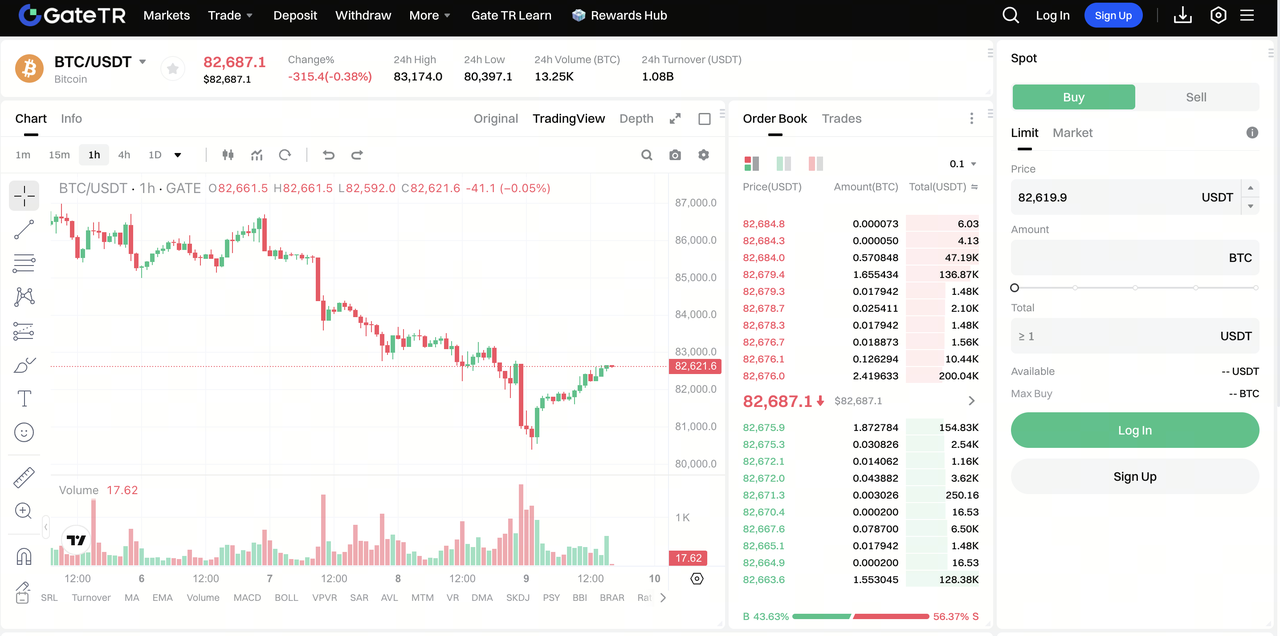
You can use the BTC/USDT spot market on Gate TR to trade Bitcoin against USDT. The following steps explain the general process; the current interface, account requirements, and available order options should be checked directly on the platform.
Step 1: Create or Access Your Gate TR Account
If you already have an account, sign in to Gate TR. If you are new to the platform, start with the Gate TR beginner’s guide to understand the platform’s main features and account setup process.
You can follow the Gate TR account creation guide for registration instructions. Use the official website and protect your login credentials.
Step 2: Complete Any Required Verification
Depending on the functions you want to access, Gate TR may require identity verification or other account checks. Review the Gate TR KYC guide for the general process.
If you need more detail about documents, identity checks, or verification requirements, consult the KYC requirements guide. Follow the requirements shown on the official platform, as the available services and verification steps may depend on the account and applicable rules.
Step 3: Open the BTC/USDT Spot Market
Visit the BTC/USDT spot trading page on Gate TR. Check that the displayed trading pair is BTC/USDT before proceeding.
BTC/USDT means that BTC is traded against USDT. The order interface shows the available market information and lets you enter the order details. Review the pair carefully before submitting a transaction.
Step 4: Check Your Available USDT Balance
Review your available balance to confirm that you have sufficient USDT for the order you intend to place. If you need to deposit funds, use the deposit instructions provided by Gate TR and verify the asset and network before transferring anything.
Do not assume that an asset sent through one network will automatically be credited if the receiving platform expects another. Check the platform’s current deposit instructions before initiating a transfer.
Step 5: Select an Available Spot Order Type
Common spot order types include market orders and limit orders, though the exact options available may vary by interface.
- Market order: Submits an order intended to execute against available orders in the order book. The execution price can vary with liquidity and order-book conditions.
- Limit order: Lets you specify the price at which you are willing to buy BTC. The order may remain unfilled if the market does not reach the specified price or there are not enough matching orders.
Review the order type, BTC quantity or USDT amount, and estimated total. Also check any applicable trading fees displayed by the platform.
Step 6: Submit the Order and Check Its Status
Once you have reviewed the details, submit the order if they match your intentions. Check the order status in the trading interface.
A market order may execute against available liquidity, while a limit order may remain open until it is filled or canceled. After execution, check your account balance to confirm the BTC credited to your account.
Step 7: Decide How to Hold Your BTC
After purchasing BTC, you can keep it in your exchange account or withdraw it to a compatible wallet if that option is available to you.
If withdrawing BTC, verify the destination address and supported network. Confirm that the receiving wallet or service supports the transfer method you select, and review any withdrawal fee and minimum amount shown by the platform. Blockchain transfers generally cannot be reversed by a central authority once confirmed.
What to Know Before Buying or Transferring BTC
Before buying BTC or moving it between wallets, consider the following practical points:
- Market risk: BTC’s market value can change, and buying it does not guarantee a particular financial outcome.
- Trading fees: Exchange trading fees are separate from Bitcoin network transaction fees.
- Confirmation times: Bitcoin transactions are not confirmed at a guaranteed interval. Congestion and fee conditions can affect how long a transaction takes.
- Custody responsibilities: Exchange custody and self-custody involve different security arrangements. With a self-custody wallet, protecting private keys and recovery information is essential.
- Network compatibility: Make sure the destination supports the network and transfer method you select.
- Public transaction records: Bitcoin transactions are recorded on a public blockchain. Bitcoin addresses are not automatically equivalent to real-world identities, but transaction activity can sometimes be linked to users.
- Verification and account requirements: Review Gate TR’s current account, identity verification, deposit, and withdrawal requirements before using a particular service.
Understanding these points helps separate the technical operation of Bitcoin from the rules and processes of a trading platform.
Summary
Bitcoin is a decentralized peer-to-peer network that uses a public blockchain, cryptographic signatures, and proof of work to record and validate BTC transactions. Its UTXO model governs how transaction outputs are spent, while its predefined issuance schedule and halving mechanism determine how new BTC enters circulation. Developments such as Taproot and the Lightning Network have also expanded aspects of Bitcoin’s transaction functionality and payment ecosystem.
To buy BTC on Gate TR, access the BTC/USDT spot market, check your available balance, choose an available spot order type, and review the order before submitting it. If you plan to transfer BTC afterward, confirm the destination address, network compatibility, and applicable fees.
Frequently Asked Questions
What is Bitcoin (BTC)?
Bitcoin is a decentralized digital currency and peer-to-peer payment network. BTC is its native asset, and transactions are recorded on a public blockchain according to the network’s protocol rules.
How does Bitcoin work?
Bitcoin transactions are created and signed by wallets, broadcast to the network, and checked by nodes. Miners use proof of work to produce blocks, and valid blocks are added to the blockchain as the network reaches consensus.
What is Bitcoin halving?
Bitcoin halving is a protocol event that reduces the block subsidy by half every 210,000 blocks, or approximately every four years. It changes the rate at which new BTC is issued, but it does not determine future market prices.
What is the difference between BTC and Bitcoin?
Bitcoin refers to the network and protocol, while BTC is the native currency used for transactions and other supported purposes within that system.
Can Bitcoin transactions be reversed?
Confirmed Bitcoin transactions generally cannot be reversed by a central authority. If you send BTC to the wrong address or an incompatible destination, recovery may not be possible. Always verify the address and transfer details before sending.
How can I buy BTC on Gate TR?
Open the BTC/USDT spot market, sign in to your account, complete any required verification, and check your available USDT balance. Select an available spot order type, review the order details, and confirm its status after submission.
What is the difference between Bitcoin and the Lightning Network?
Bitcoin’s base layer records transactions on the main blockchain. The Lightning Network is a separate payment protocol built on top of Bitcoin that uses payment channels to support certain off-chain transfers. Wallet and service support may differ, so users should verify the transfer method before sending BTC.
Disclaimer
* Legal Notice 1: This content does not constitute investment advice. It is not intended to promote the buying/selling of digital assets and is for informational purposes only. Crypto assets carry high risks and may be subject to significant price fluctuations. Before making any investment decision, you should assess your own financial situation and make an independent decision.
* Legal Notice 2: The data and charts provided in the article are for general informational purposes only. Although all content is carefully prepared, no responsibility is accepted for possible errors or omissions. The Gate TR Learn team may translate this content into different languages. No translated article may be copied, reproduced, or distributed without permission.
Share
Content
Key Takeaways
What Is Bitcoin (BTC)?
How Does Bitcoin Work?
Bitcoin Supply and the Halving Mechanism
What Is Bitcoin Used For?
Bitcoin Network Developments: Taproot and the Lightning Network
Bitcoin vs. Ethereum: Key Differences
How to Buy BTC on Gate TR
What to Know Before Buying or Transferring BTC
Summary
Frequently Asked Questions


Sign Up
Related Articles
Intermediate
Spot Crypto ETFs: Global Rise and Turkey’s Roadmap
What are spot crypto ETFs, how do they work, and why are they important? In this comprehensive Turkey-based analysis, we explore global ETF trends, the increasing interest of governments and institutional investors in crypto, regulatory frameworks, and future projections in depth.
2025-11-18 08:29:40


Beginner
November 2025 Crypto Summary: Institutional Adoption and Market Dynamics
November 2025 Crypto Summary: Institutional Adoption and Market Dynamics
2026-01-06 08:48:48