PIN AI: A Revolution in Data Privacy and Personalized Artificial Intelligence
2025-11-24 11:05:59
Advanced
AILearn how PIN AI addresses digital identity fragmentation and delivers truly personalized AI services through its decentralized architecture. Discover the benefits of secure edge computing and Trusted Execution Environments (TEEs) for data privacy.
In today’s digital world, personal data is scattered across platforms owned by tech giants, limiting users’ control over their own information. Popular AI applications like ChatGPT and Google Gemini rely on centralized data storage systems, which prevents them from offering truly personalized services. This increases privacy concerns and prevents users from experiencing customized interactions.
PIN AI addresses these issues by introducing a decentralized personal intelligence system that secures user data. With secure edge computing and Trusted Execution Environment technologies, users can interact seamlessly with AI agents tailored to their needs while their personal data remains protected.
PIN AI empowers users with full control over their data, enabling them to benefit from the full potential of AI. This creates a new generation of AI that protects privacy and adapts to personal needs, separating it from existing systems.
What is PIN AI?
PIN AI (Personal Intelligence Network AI) is an open platform designed for personalized artificial intelligence. It allows users to train and deploy AI models tailored to their needs, while owning and controlling their personal data.
PIN AI combines on-device computation, Trusted Execution Environment security, and blockchain verification to enable secure and seamless interactions between humans and AI agents.
The platform connects users with a marketplace of specialized AI agents for tasks like scheduling, data analysis, financial management, and daily digital activities. All operations are performed while protecting personal data and prioritizing user privacy.
Key Features and Benefits
- Decentralized Device Intelligence: AI models are trained and deployed directly on users’ devices. This improves privacy and security and eliminates the need for centralized data storage.
- Secure Edge Computing: Local data processing reduces breach risks and ensures sensitive information never leaves the user’s device.
- Trusted Execution Environments (TEEs): TEEs create isolated environments for secure computation within devices. This protects data and AI interactions from external threats.
- Data Ownership: Users have full control over their personal data. They can manage, share, and even monetize their data as they choose.
- Agent Economy: PIN AI creates a marketplace for AI agents capable of performing various tasks such as scheduling appointments, data analysis, and financial management. This system improves the efficiency of personal AI agents and creates value for users.
PIN AI Operational Scope
Personal Artificial Intelligence
PIN AI is built around personal AI models that can be shaped according to individual needs and preferences. While traditional AI systems operate through centralized servers, PIN AI’s Personal AI models are trained and deployed directly on user devices. This approach ensures personal AI provides tailored assistance while preserving privacy and security.
Data Ownership
One of PIN AI’s core principles is data ownership. Today, users’ personal data is typically controlled and managed by big tech companies. This limits users’ ability to freely manage and benefit from their own data.
PIN AI solves this problem by giving users full control over their data. Users can decide which data to share, with whom, and under what conditions. This system allows individuals to monetize their data if they choose, while maintaining privacy.
Agent Economy
PIN AI introduces an Agent Economy concept where specialized AI agents can perform a wide range of tasks. These AI agents can handle tasks such as scheduling, data analysis, financial management, and daily digital activities.
The Agent Economy provides a marketplace where users can access AI agents tailored to their specific needs. This system brings AI usage to a new level by making it more effective and personalized in daily life.
PIN Artificial Intelligence Architecture
PIN Onchain Protocol
The PIN Onchain Protocol uses blockchain-based smart contracts to ensure the integrity and security of data processing and AI agent interactions. This protocol enables on-chain verification processes to create a secure and transparent AI ecosystem.
PIN AI provides a Verifiable Computing Framework to ensure the accuracy and trustworthiness of decentralized computation. This framework verifies Trusted Execution Environment (TEE) reports on-chain and monitors decentralized service operations. Technologies such as God Models, Data Binders, and On-device Large Language Models (LLMs) are key components of this system. Thus, all computation is performed transparently, tamper-proof, and reliably.
The Agent Registry is a decentralized ledger for AI agents and data services within the PIN AI network. This system creates a comprehensive list including reputation scores and staking mechanisms for each AI agent. Users can select and deploy the most suitable AI agents based on performance and reliability criteria. This registry strengthens trust and accountability within the PIN AI ecosystem.
PIN On-Chain Verification
The PIN Onchain Protocol verifies TEE reports on-chain, ensuring only trusted and validated computations run. This process checks the integrity of nodes and their performed operations. Additionally, the protocol verifies zk-proofs generated by AI agent operations, enhancing security and transparency. The PIN Onchain Protocol includes worker monitoring to ensure nodes remain connected, stable, and high-performance. This process maintains the health and efficiency of the ecosystem, ensuring reliable and continuous AI service.
Personal AI Protocol
Data Binders
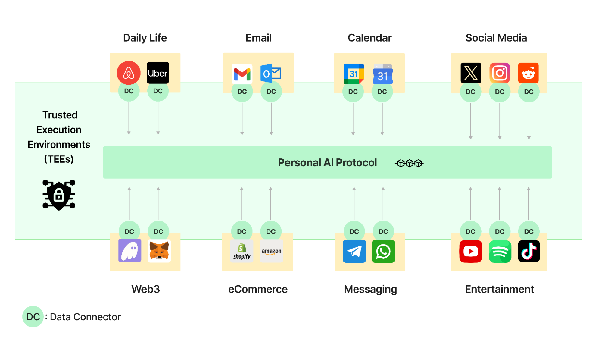
Data Binders securely receive, process, and structure personal data within Trusted Execution Environments (TEEs). These components connect to Web2 and Web3 platforms such as Google, Apple, Meta, Amazon, MetaMask and Phantom to securely manage user data. Data Binders create a personal knowledge graph, making this data accessible and optimized for personal AI models. This enables AI models to produce more accurate and personalized responses.
How Data Binders Work
After authorization, API calls access the user’s data, which is processed into a personalized knowledge graph. Secure processing is verified through TEE validation reports submitted to the PIN Onchain Protocol.
Depending on user choice, verified data is securely stored on-device, in the cloud, or in dedicated storage. This preserves privacy while enabling direct AI access to the data.
On-Device Language Modeling (Personal Artificial Intelligence)
Large Language Models (LLMs) run directly on the user’s device to ensure full control over personal data. Local data processing on devices such as smartphones, laptops, or private cloud systems preserves privacy.
Key Features of On-Device LLMs
- Contextual personalization is enabled through a continuously updated Personal Index. User interactions, history, and preferences are analyzed to produce highly personalized results.
- A hybrid architecture combines local processing with optional cloud resources to provide a scalable and autonomous AI experience for complex tasks.
- Trusted hardware enclaves (TEEs) prevent unauthorized access, ensuring data remains exclusively under user control.
- Iterative learning capabilities allow the model to continuously adapt and improve based on user needs.
How Do On-Device LLMs Work?
LLM models are stored in a compressed format on the user’s SSD/HDD or in a private cloud, and accessed through the PIN AI application. AI computations run directly on the device’s CPU or GPU, keeping sensitive processing local to ensure privacy. With a hybrid approach, cloud resources supplement local processing when needed, delivering scalable performance. Background learning and model updates analyze user behavior during idle time, enabling continuous adaptation of the personal AI.
Guardian of Data Models (God-Models)
God-Models are specialized verification models operating within the PIN AI Network. Operating inside Trusted Execution Environments (TEEs), they continuously evaluate personal AI models and verify their alignment with user data. They also provide feedback for personal AI improvement and detect malicious data manipulation or threats while maintaining system integrity.
Evaluation Framework of God-Models
- Initialization: The Personal AI records verified data sources, interaction history, and activity patterns.
- Periodic or Random Queries: The God-Model evaluates the Personal AI’s ability to provide context-aware responses.
- Response Verification: AI responses are compared against stored logs or verified data to assess accuracy.
- Score Adjustment: The God-Model assigns a “knowledge score” based on accuracy and reliability and updates it as needed.
This system ensures AI agent safety and efficiency, building a robust and trustworthy AI infrastructure across the PIN AI ecosystem.
Intent Matching Protocol
The Intent Matching Protocol is a core component of the PIN AI platform that enables seamless interaction between Personal AI and external AI agents. This protocol allows users to express their intent toward an AI — meaning a specific service request or action — and enables AI agents to compete to fulfill those requests. This results in an efficient, privacy-preserving, and verifiable service execution process.
Key Components of the Intent Matching Protocol
- Intent Submission: Users submit specific service or action requests through Personal AI, including category, budget, time limits, and parameters. These requests may include the service category, budget, time constraints, and other custom parameters.
- Offer Submission: AI agents submit competitive offers including capabilities, pricing, and reputation scores. These bids include information such as service capabilities, pricing details, and reputation scores. The bidding process enables AI agents to showcase their strengths and expertise, ensuring they deliver the best possible service.
- Intent Matching Algorithm: The protocol uses an intent-matching algorithm to evaluate agent bids based on various factors such as preference embeddings, bid competition, and reputation metrics. This algorithm ensures the chosen AI agent delivers optimal service quality at minimal cost.
PIN AI’s Intent Matching Protocol features a dynamic structure that provides users with personalized and reliable AI-powered services while enabling AI agents to operate more efficiently and effectively.
Agent Services Protocol
The Agent Services Protocol is a decentralized marketplace that connects Personal AI with specialized AI agents. It facilitates intent matching, transparent execution, and programmable payments. It also creates an open, competitive economy for AI agents, fostering innovation.
Key Components of the Agent Services Protocol
- Agent Service Economy: It establishes a fair and efficient economic framework for AI agents by supporting micropayments, programmable payments, shared ownership mechanisms, and off-chain reputation tracking. Users can pay per task or automate recurring payments. The shared ownership model incentivizes collaborative development of AI agents, while reputation systems help users choose reliable AI agents. Thanks to transparent transactions, AI agents are fairly compensated.
- Agent Communication Protocol: It uses Trusted Execution Environments (TEEs) to secure communication between users and AI agents. Sensitive data is protected and unauthorized access is prevented. Off-chain verification mechanisms audit the reliability and accuracy of services. This system ensures that AI services operate transparently and with accountability.
Trusted Execution Environments
Trusted Execution Environments are isolated areas within processors or data centers where programs run independently from the rest of the system and remain protected from interference. These environments ensure the integrity and authentication of computations while protecting sensitive data.
TEEs protect internal data and processes even if the main system is compromised. This isolates AI computations and user data from external threats, maximizing privacy and security.
TEE Services
Trusted Execution Environments in the PIN AI network execute sensitive tasks securely and in isolation. They ensure secure data processing and trustworthy AI computations while preserving privacy and integrity.
TEE nodes can be customized for different workloads and use cases, while maintaining high security standards. They host Data Connectors in a confidential environment and securely process user data. They also perform private LLM inference and privacy-preserving computations for sensitive AI tasks in the PIN AI network.
This system ensures that all critical processes, from data processing to advanced model inference, are performed transparently and under user control. This delivers the highest level of data protection and operational reliability.
TEE Device Verification
Verification is crucial to ensure that TEE devices provide a trusted environment. The process confirms the integrity of the TEE hardware and verifies that its certificate chain is issued by a trusted manufacturer.
A TEE undergoes remote attestation before executing any program. This ensures at the hardware level that the TEE only runs approved and untampered code.
Data Connectors record verification details on-chain as metadata, ensuring transparency and auditability. TEE devices are registered to the PIN AI network through this process.
TEE Task Verification
TEE task verification confirms that tasks executed by TEE nodes are completed securely and correctly. Failed tasks are penalized, ensuring network security.
The process follows these steps:
- Proof Submission: The TEE node submits proof of its work to Validators on the PIN Chain.
- Verification: Validators check whether the proof is valid and the task has been completed correctly.
- Accountability: If the task fails, the TEE node is penalized by losing staked funds.
This verification process ensures that all TEE nodes in the PIN AI ecosystem operate securely, reliably, and with accountability.
PIN Protocol Economy
The PIN protocol forms the foundation of the open-source ecosystem built around PIN AI. It supports trust-based data sharing, activity tracking, and value exchange, enabling controlled access to personal data and an open innovation platform for new AI services. The PIN protocol ensures the integrity and security of all data interactions within the PIN AI network, creating a strong and transparent ecosystem.
How the PIN Protocol Economy Is Bootstrapped
The PIN protocol operates as a two-sided marketplace, integrating users and Personal AIs with external AI systems. As users share more contextual data, service value increases and interactions become more meaningful.
The Proof-of-Engagement (PoE) protocol provides incentives through two main components to encourage participation.
- Data Link Incentives reward users for connecting their data to the PIN network. Data is protected with strong encryption mechanisms. Sybil attacks are prevented using zkTLS, digital behavior analysis, and digital identity systems such as WorldID.
- Proof-of-Valuable-Transactions allows users to earn rewards by completing transactions with economic value. Transactions completed with crypto or fiat are recorded on-chain in a verifiable manner. For example, fiat transactions are securely verified using zkTLS.
This system encourages data sharing while making high-value interactions provable, accelerating ecosystem participation.
Main Participants in the PIN Ecosystem
- End users are incentivized to connect their personal data to the PIN network. They benefit from the system while preserving data ownership and privacy through Data Connectors. Shared data provides contextual richness, helping agent services better respond to user intent.
- Data Connectors are part of the infrastructure serving the PIN network and are operated by third parties. The network is secured through a stake-and-slash mechanism, rewarding operators and stakers for their contributions.
- Agent Services can be easily deployed through Agent Connectors. These agents provide personalized services using users’ contextual data, allowing them to respond more effectively to user intent. Agent service operators are protected and incentivized through crypto-economic security mechanisms.
PIN AI Application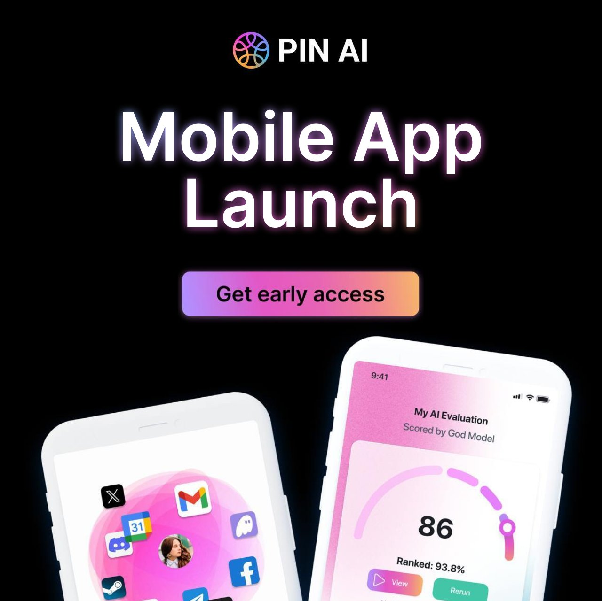
On February 13, 2025, PIN AI launched its privacy-focused AI application, offering users a customizable AI experience that runs directly on their smartphones. Using open-source models such as DeepSeek and Llama, the app delivers fully personalized AI services while processing data in a secure environment.
Available on iOS and Android, the PIN AI app aggregates personal data from various sources, such as Google and financial services, into a secure “data vault.” Users can ask PIN AI questions for functions such as GOD Rating (AI Understanding Metric), travel planning, and personalized recommendations. All data processing occurs on-device, ensuring privacy and maintaining a dedicated network balance.
PIN AI’s business model operates similarly to Ethereum’s gas-fee structure, charging minimal fees when users explicitly authorize their data to be shared with third-party AI services. This model balances data sharing and privacy while keeping user control at the forefront.
The app was first rolled out on Android and made available to early adopters through the Discord community. Later, the iOS version was launched, initially through an invite-only beta phase before becoming publicly available. PIN AI aims to deliver a unique AI experience by combining privacy, personalization, and advanced AI capabilities.
PIN AI Funding Journey
PIN AI has received significant investment to support its mission of building a decentralized and personalized AI platform. Strategic funding from venture capital firms and angel investors has accelerated PIN AI’s growth.
In September 2024, PIN AI raised $10 million in its pre-seed funding round. The round was led by Andreessen Horowitz (a16z), known for backing innovative tech startups. Other notable participants included Hack VC, Foresight Ventures, and angel investors Illia Polosukhin and Scott Moore.
Conclusion
PIN AI introduces a new approach to solving data fragmentation and privacy challenges by combining decentralized device intelligence, secure edge computing, and Trusted Execution Environments (TEEs).
This innovative model strengthens user control over data while enabling personalized AI interactions. PIN AI’s strong architecture, built on its Personal AI Protocol, Intent-Matching Protocol, and Agent Services Protocol, aims to create a decentralized AI ecosystem prioritizing data ownership and privacy.
Share
Content
What is PIN AI?
Key Features and Benefits
PIN AI Operational Scope
PIN Artificial Intelligence Architecture
Personal AI Protocol
On-Device Language Modeling (Personal Artificial Intelligence)
Guardian of Data Models (God-Models)
Intent Matching Protocol
Agent Services Protocol
Trusted Execution Environments
PIN Protocol Economy
Main Participants in the PIN Ecosystem
PIN AI Funding Journey
Conclusion


Sign Up
Related Articles

Beginner
What is HyperGPT (HGPT)?
This article offers an in-depth look into the infrastructure, products, and ecosystem of the HyperGPT (HGPT) project, while focusing on the problems that HyperGPT aims to solve.
2025-05-16 18:10:16

Intermediate
Bitcoin İçin Yeni Bir Başlangıç mı? Nubit, Babylon, Bitlayer Çatışması
Bitcoin’ın teknolojik evriminin kavşağında, karşımızda üç farklı yaklaşım var: Nubit, Bitcoin’ın yerel ölçeklenmesini ve temel değerlerine bağlılığını savunuyor; Babil, çapraz zincir entegrasyonu ve sermaye verimliliğini öne çıkarıyor; Bitlayer ise başarılı modelleri kopyalayarak pragmatik bir yaklaşım sunuyor.
2025-05-16 14:02:46