What Is Cardano (ADA)? A Guide to Its Blockchain and How to Buy ADA on Gate TR
Last Updated 2026-10-13 04:05:42
ADA is the native cryptocurrency of Cardano. It is used to pay transaction fees, participate in the network’s staking and delegation system, and take part in on-chain governance under the network’s current rules. Cardano also supports native tokens and smart contracts, allowing developers to build applications that operate on its blockchain.
This guide explains how Cardano works, what makes its technology different, how ADA is used, and how to buy ADA on Gate TR. It also covers Cardano’s recent governance developments and practical considerations for trading and transferring ADA.
Key Takeaways
- Cardano is a proof-of-stake blockchain: Its Ouroboros consensus protocol coordinates block production through stake pools rather than proof-of-work mining.
- ADA is Cardano’s native asset: It is used for transaction fees, staking delegation, and participation in network governance.
- Cardano uses an extended UTXO model: Its eUTXO transaction model combines UTXO-based accounting with additional information that supports smart contract execution.
- Cardano supports smart contracts and native tokens: Developers can build decentralized applications and issue tokens using Cardano’s ledger and programming tools.
- On-chain governance is an established part of the network: Cardano’s Conway era and Plomin upgrade expanded community participation in protocol decisions and treasury governance.
- ADA is available through the Gate TR spot market: Users can visit the ADA/USDT market, review the available order options, and place a spot order after meeting applicable account requirements.
What Is Cardano (ADA)?
Cardano is a decentralized blockchain network that aims to support secure transaction processing, smart contracts, and decentralized applications. Its development has been organized around a series of technical eras, each introducing capabilities such as proof-of-stake consensus, smart contracts, scaling improvements, and decentralized governance. The project publishes technical documentation and development information for its protocol and ecosystem. Cardano roadmap
ADA is the native cryptocurrency of the Cardano network. It can be transferred between compatible wallets and used to pay transaction fees. ADA holders can also delegate their stake to a stake pool and participate in Cardano’s governance system according to the applicable protocol rules.
Cardano and ADA refer to different things. Cardano is the blockchain network and its supporting technology, while ADA is the digital asset used within that network. Applications built on Cardano may also use other tokens, but those tokens are not the same as ADA.
How Does Cardano Work?
Cardano combines a distributed ledger, a proof-of-stake consensus protocol, and a transaction model designed to support both asset transfers and smart contracts. These components determine how transactions are validated, how new blocks are produced, and how applications interact with the network.
1. A Distributed Blockchain Ledger
Cardano maintains a shared ledger of transactions and other network activity. Participants use compatible node software to verify transactions and blocks according to the protocol’s rules. This allows the network to maintain a common transaction history without depending on one central database operator.
When a user sends ADA, a wallet constructs and signs a transaction. The transaction is submitted to the network, where nodes check whether it follows the ledger rules. Valid transactions can then be included in a block and added to the blockchain.
The ledger also supports native tokens and smart contract operations. As a result, Cardano is not limited to transfers of ADA; it can record and process activity associated with applications built on the network.
2. Ouroboros Proof of Stake
Cardano uses Ouroboros, a proof-of-stake consensus protocol. Instead of requiring miners to compete through computational work, Ouroboros selects stake pools to participate in block production according to the protocol’s rules and the network’s stake distribution.
A stake pool is operated by a participant who maintains the infrastructure needed to help produce blocks. ADA holders can delegate their stake to a pool, allowing them to participate in the staking system without operating their own pool. Delegation supports the consensus process, while the underlying ADA generally remains available to the holder for normal wallet transactions, subject to the wallet and protocol arrangements involved.
Proof of stake differs from Bitcoin’s proof-of-work model. Bitcoin uses computational work to produce blocks, whereas Cardano’s Ouroboros protocol uses stake-based selection and consensus rules. Both systems have their own security assumptions and technical trade-offs.
3. Epochs, Slots, and Block Production
Cardano organizes time into epochs, which are divided into slots. A slot is a period in which a block may be produced, while an epoch groups many slots together and is used in parts of the protocol’s stake and block-production processes.
For each slot, a stake pool may be selected as the slot leader under Ouroboros. The selected pool can then produce a block if it meets the protocol’s requirements. Other network participants verify the block and update their local view of the ledger.
This structure allows Cardano to coordinate block production without a mining race. It also means that block production depends on the consensus protocol, stake distribution, and the participation of network infrastructure.
What Makes Cardano’s Technology Different?
Cardano has several technical features that distinguish it from blockchains built around different transaction models or development priorities.
The Extended UTXO Model
Cardano uses an extended Unspent Transaction Output model, commonly called eUTXO. Like Bitcoin’s UTXO model, it tracks unspent transaction outputs that can be consumed by later transactions. Cardano extends this approach with additional information and script functionality to support smart contract operations.
In a UTXO-based system, a transaction consumes eligible outputs and creates new outputs. Each output has conditions that determine how it can be spent. Cardano’s eUTXO model allows transaction outputs to carry data and interact with validation scripts, making it possible to support application logic while retaining a UTXO-based ledger structure.
This architecture affects how developers design smart contracts and how transactions are constructed. It also means that Cardano applications may handle transaction inputs, outputs, and execution constraints differently from applications on account-based networks such as Ethereum.
Plutus and Smart Contracts
Cardano supports smart contracts through its scripting and execution infrastructure. Plutus is a key component of Cardano’s smart contract platform, providing tools and script functionality for developers to create on-chain application logic.
Smart contracts can define rules for transferring tokens, managing application state, or validating whether a transaction meets specified conditions. Developers can use them to build decentralized exchanges, lending applications, governance systems, and other blockchain-based services.
A smart contract’s behavior depends on its code and design. Cardano’s underlying protocol does not automatically guarantee that every application is secure, reliable, or free from vulnerabilities. Users should review an application’s documentation, permissions, and risk disclosures before interacting with it.
Native Tokens
Cardano supports native assets that can be tracked and transferred by the ledger without requiring each asset to use a separate smart contract merely to represent basic token balances. These assets can be created for different purposes, including community tokens, digital collectibles, and application-specific assets.
Native tokens can be transferred alongside ADA, subject to transaction requirements and any relevant application rules. Although native assets share Cardano’s underlying ledger infrastructure, their issuers, distribution mechanisms, and intended uses can differ significantly.
ADA remains the network’s native cryptocurrency and is used for transaction fees. A token created on Cardano does not become ADA simply because it operates on the same blockchain.
What Is ADA Used For?
ADA has several roles within the Cardano ecosystem. Its main functions include paying transaction fees, participating in proof-of-stake consensus through delegation, and supporting governance participation.
Paying Transaction Fees
Cardano transactions require fees paid in ADA. These fees compensate for the resources used to process transactions and help support the network’s operation.
The fee for a transaction can depend on protocol parameters and transaction characteristics. A simple ADA transfer and a more complex transaction involving native tokens or smart contracts may have different requirements.
Cardano network fees are distinct from fees charged by a cryptocurrency exchange. If you buy ADA on Gate TR, any exchange trading fee is separate from the network fee that may apply if you later withdraw ADA to an external wallet.
Staking and Delegation
ADA holders can delegate their stake to a stake pool to participate in Cardano’s proof-of-stake system. Delegation allows holders to contribute to the network’s consensus process without having to run a stake pool themselves.
Delegating ADA is different from sending it to another person or selling it. In the Cardano protocol, delegation generally changes how stake is assigned for consensus participation rather than transferring ownership of the ADA to the pool operator. Wallet interfaces and third-party services may offer different staking-related features, so users should understand the arrangement they are using.
Participation and rewards are subject to the protocol’s rules and the performance of the selected pool. Delegation should not be confused with a guaranteed return, and it is not automatically enabled when ADA is purchased on an exchange.
Participating in On-Chain Governance
Cardano’s governance system allows eligible participants to take part in decisions about the network’s development and operation. Under the governance framework introduced through CIP-1694 and the Conway era, governance roles include delegated representatives (DReps), stake pool operators, and the Constitutional Committee.
ADA holders can participate directly in certain governance processes or delegate their voting power to a DRep. Governance actions can cover matters such as protocol updates, treasury withdrawals, and other decisions defined by the system’s rules.
The Plomin hard fork in January 2025 activated the second stage of Cardano’s governance changes, enabling the full set of governance actions described in the relevant framework. Governance participation remains subject to the network’s procedures and the eligibility rules for each action.
Cardano’s Ecosystem and Development
Cardano’s development has progressed beyond its original focus on a distributed ledger and proof-of-stake consensus. Its current architecture includes smart contracts, native tokens, and on-chain governance, while work continues on protocol improvements and ecosystem infrastructure.
Decentralized Applications and DeFi
Cardano’s smart contract functionality allows developers to create decentralized applications, including services for token exchange, lending, asset management, and decentralized governance. These applications use Cardano’s ledger and scripting infrastructure to execute predefined rules.
The available functionality depends on each application’s implementation and supporting infrastructure. Users should distinguish between features supported by the Cardano protocol and services offered by individual projects. A decentralized application may have additional risks related to smart contracts, liquidity, administration, or external dependencies.
Scaling and Network Development
Cardano’s development roadmap includes work on scalability, interoperability, and improvements to the developer experience. These areas cover different technical challenges: scaling concerns how the network handles activity, interoperability concerns how systems exchange information or assets, and developer tooling concerns how applications are built and maintained.
Not every roadmap item is available as a completed mainnet feature. For current implementation status, users should consult official Cardano documentation and upgrade records rather than treating proposed features as already deployed.
Community Governance and Protocol Updates
Cardano’s governance model has evolved to give the community a formal role in protocol decisions. The network’s governance documentation describes how DReps, stake pool operators, and the Constitutional Committee participate in different types of governance actions.
This system is important because a public blockchain must not only process transactions but also coordinate changes to its rules. Governance procedures provide a framework for considering upgrades, protocol parameters, and treasury decisions. The outcome of any individual proposal depends on the applicable voting process and the participants involved.
Cardano (ADA) vs. Ethereum (ETH)
Cardano and Ethereum both support smart contracts and decentralized applications, but their architectures and consensus mechanisms differ.
| Feature | Cardano | Ethereum |
|---|---|---|
| Native asset | ADA | ETH |
| Consensus mechanism | Ouroboros proof of stake | Proof of stake |
| Transaction model | Extended UTXO (eUTXO) | Account-based state model |
| Smart contract infrastructure | Plutus and Cardano scripting tools | Ethereum Virtual Machine (EVM) |
| Native asset support | Native tokens supported by the ledger | Tokens commonly issued through smart contracts |
| Staking participation | ADA can be delegated to stake pools | ETH can be staked through validator arrangements |
| Governance | On-chain governance framework with DReps, stake pool operators, and a Constitutional Committee | Protocol development involves a broad ecosystem of developers, client teams, validators, and other participants |
The two networks make different architectural choices. Cardano’s eUTXO model and stake-pool-based consensus differ from Ethereum’s account model and EVM environment. These differences influence application design, transaction construction, and the tools developers use.
Neither architecture guarantees that every application is safe or suitable for every purpose. Users should evaluate the specific network and application involved rather than relying on a general comparison alone.
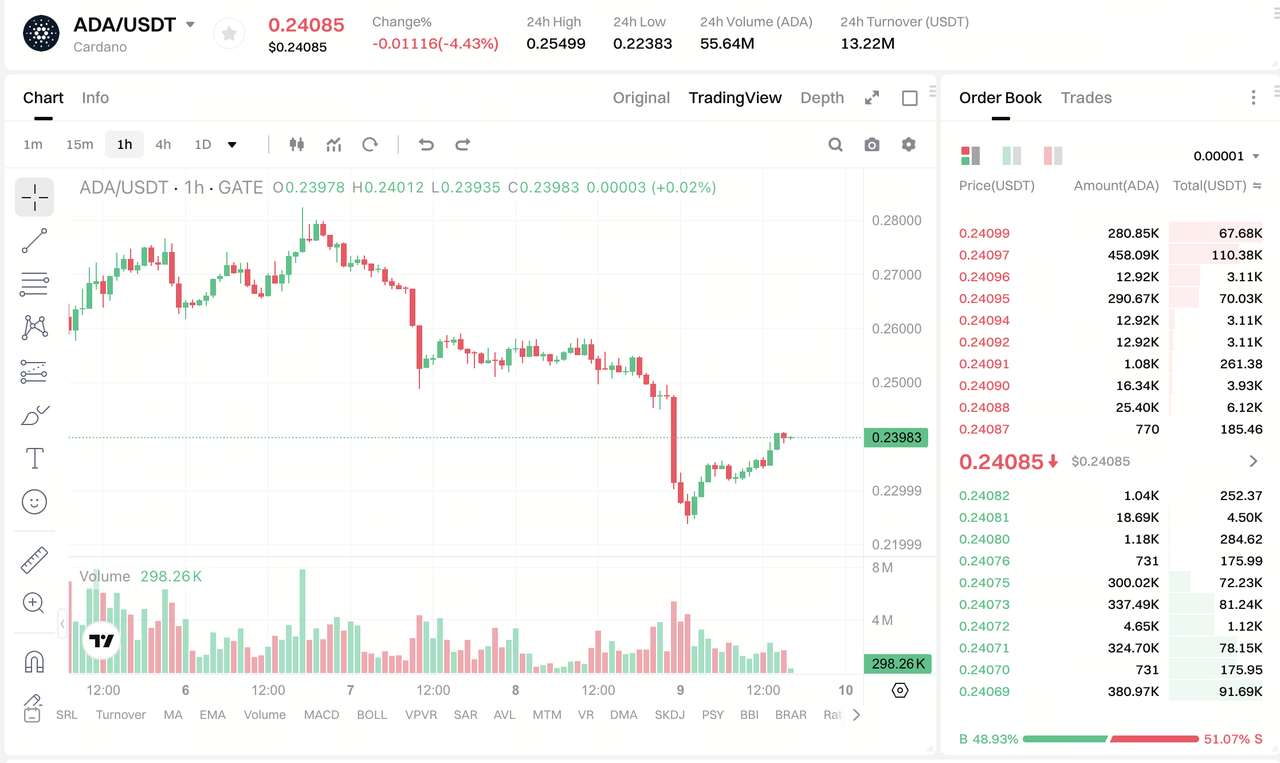
How to Buy ADA on Gate TR
You can use the ADA/USDT spot market on Gate TR to trade Cardano’s native asset against USDT. Before placing an order, confirm the trading pair, review the available order options, and check your account’s current requirements.
Step 1: Create or Sign In to Your Gate TR Account
If you already have a Gate TR account, sign in through the official website. If you are new to the platform, the Gate TR beginner’s guide provides an overview of the platform and its main features.
You can also follow the account creation guide for registration instructions. Use the official website and keep your login details secure.
Step 2: Complete Any Required Identity Verification
Depending on your account status and the functions you want to use, identity verification may be required. Review the Gate TR KYC guide for an overview of the process.
If you need additional information about verification documents and requirements, consult the KYC requirements guide. Follow the requirements displayed by Gate TR, as the process and available services may change.
Step 3: Open the ADA/USDT Spot Market
Visit the ADA/USDT spot trading page on Gate TR. Confirm that the selected market is ADA/USDT before entering an order.
In this trading pair, ADA is the asset being bought or sold, and USDT is the asset used to quote the trading price. Review the market information and the order form before proceeding.
Step 4: Check Your Available USDT Balance
Check your available balance to confirm that you have enough USDT for the order you intend to place. If you need to deposit assets, follow the current instructions on Gate TR and verify the deposit asset and network before transferring funds.
Do not assume that a transfer sent through one network will be credited if the receiving platform expects another. Always check the deposit instructions for the specific asset and destination.
Step 5: Choose an Available Spot Order Type
The trading interface displays the order types currently available for the selected market. Common spot order types include:
- Market order: An order intended to execute against available orders in the order book. The final execution price may vary depending on liquidity and order-book conditions.
- Limit order: An order that specifies the price at which you are willing to buy ADA. It may remain unfilled if the market does not reach the specified price or if there are not enough matching orders.
Enter the amount of ADA you want to buy or the USDT amount you want to use, as supported by the interface. Review the order type, quantity, estimated total, and any applicable trading fees before submitting.
Step 6: Submit the Order and Check Its Status
Submit the order only after confirming that the details match your intentions. Then check the order status in the trading interface.
A market order may execute against available liquidity, while a limit order may remain open until it is filled or canceled. After execution, check your account balance to confirm that the ADA has been credited.
Step 7: Decide How to Hold Your ADA
After buying ADA, you can keep it in your exchange account or withdraw it to a compatible Cardano wallet if that option is available to you.
Before withdrawing, confirm the destination address and any withdrawal requirements shown by Gate TR. If you use a self-custody wallet, protect your recovery phrase and private keys. Losing access to these credentials may prevent you from recovering your funds.
Holding ADA on an exchange is also different from delegating ADA through a Cardano wallet. Purchasing ADA does not automatically mean it has been delegated to a stake pool or that you are participating in on-chain governance.
Summary
Cardano is a proof-of-stake blockchain that uses the Ouroboros consensus protocol and an extended UTXO transaction model to support ADA transfers, smart contracts, native tokens, and decentralized applications. ADA is used to pay transaction fees, participate in staking delegation, and take part in Cardano’s on-chain governance system. Governance upgrades such as Chang and Plomin have expanded the formal role of community participants in network decisions.
To buy ADA on Gate TR, open the ADA/USDT spot market, check your available balance, choose an available spot order type, and review the order before submitting it. If you later transfer ADA to a personal wallet, verify the destination details and understand the responsibilities associated with self-custody.
Frequently Asked Questions
What is Cardano (ADA)?
Cardano is a decentralized proof-of-stake blockchain that supports digital asset transfers, smart contracts, and decentralized applications. ADA is its native cryptocurrency and is used for network fees, staking delegation, and governance participation.
How does Cardano work?
Cardano uses the Ouroboros proof-of-stake protocol to coordinate block production through stake pools. Its distributed ledger validates transactions according to protocol rules and supports ADA, native tokens, and smart contract operations.
What is ADA used for?
ADA is used to pay Cardano transaction fees, transfer value, delegate stake to stake pools, and participate in the network’s governance system under applicable rules.
What is the difference between Cardano and ADA?
Cardano is the blockchain network and its underlying technology. ADA is the native cryptocurrency used within that network. Other tokens and applications can also operate on Cardano without being ADA.
Does Cardano use proof of stake?
Yes. Cardano uses Ouroboros, a proof-of-stake consensus protocol. Stake pools participate in block production, and ADA holders can delegate their stake to a pool without necessarily operating one themselves.
What is Cardano’s eUTXO model?
The extended Unspent Transaction Output model is Cardano’s approach to tracking spendable transaction outputs. It extends the UTXO model with additional information and script functionality to support smart contracts.
How can I buy ADA on Gate TR?
Visit the ADA/USDT spot market, sign in to your Gate TR account, complete any required verification, and check your available USDT balance. Select an available spot order type, review the order details, and check the order status after submission.
Can I stake ADA after buying it?
ADA holders can generally delegate their stake to a Cardano stake pool through compatible wallets and services. Buying ADA on an exchange does not automatically delegate it. Check the wallet or service’s current features and conditions before participating.
What is Cardano’s on-chain governance system?
Cardano’s on-chain governance framework allows eligible participants to take part in decisions about protocol changes, treasury actions, and other governance matters. Roles include delegated representatives, stake pool operators, and the Constitutional Committee.
Disclaimer
* Legal Notice 1: This content does not constitute investment advice. It is not intended to promote the buying/selling of digital assets and is for informational purposes only. Crypto assets carry high risks and may be subject to significant price fluctuations. Before making any investment decision, you should assess your own financial situation and make an independent decision.
* Legal Notice 2: The data and charts provided in the article are for general informational purposes only. Although all content is carefully prepared, no responsibility is accepted for possible errors or omissions. The Gate TR Learn team may translate this content into different languages. No translated article may be copied, reproduced, or distributed without permission.


Related Articles
Beginner
The Legal Journey of Cryptocurrencies in Turkey
This content outlines the definition, historical development, underlying reasons, and necessities of cryptocurrency regulations in Turkey.
2025-11-18 08:41:34

Beginner
What is HyperGPT (HGPT)?
This article offers an in-depth look into the infrastructure, products, and ecosystem of the HyperGPT (HGPT) project, while focusing on the problems that HyperGPT aims to solve.
2025-05-16 18:10:16